
Introduction
The year 2026 marks a structural shift in how the world powers its civilization. We have moved into what the International Energy Agency (IEA) officially calls the “Age of Electricity”. This era is defined by the “Great Realignment,” where the global energy transition is no longer driven solely by climate mandates, but by a powerful new engine: national security. Following successive geopolitical shocks, including the 2026 Middle East crisis and the physical closure of the Strait of Hormuz, nations are racing to decouple from volatile fossil fuel supply chains in favor of domestic, electrified solutions. While the world still uses record amounts of energy, the way we meet new demand is shifting rapidly from burning molecules to moving electrons.
The Surge of the Electric Era
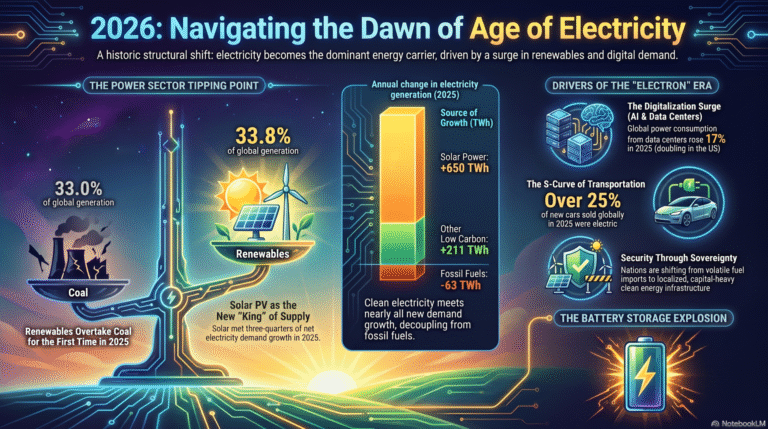
Electricity has become the central component of the global energy transformation. In 2025, global electricity demand grew by roughly 3%, nearly twice the rate of total energy supply growth. For the first time in modern history outside of a recession, modern renewables and hydropower combined to overtake coal as the largest source of electricity generation globally, accounting for 33.8% of the mix.
The undisputed king of this growth is Solar Power. In 2025, solar generation expanded by 600 terawatt-hours (TWh), the largest single-year increase for any individual energy source ever recorded. Solar alone met 75% of the net increase in global electricity demand that year. This rapid scaling is supported by a massive explosion in battery storage, which grew by 66% in 2025, helping to turn “daytime solar” into reliable “anytime solar”.
Energy Security: A New National Imperative
The physical closure of the Strait of Hormuz in early 2026, which temporarily halted over 20% of global liquefied natural gas (LNG) and up to 14.4 million barrels of oil per day, fundamentally changed the logic of energy security. Nations have realized that relying on long, fragile, and volatile fossil fuel supply chains is a strategic liability.
In response, many countries are pivoting toward energy sovereignty. Because technologies like wind and solar represent one-off capital investments that harvest local resources, they provide predictable energy costs that are immune to foreign transit disruptions. For example, the European Union’s rapid deployment of wind and solar since 2022 has already avoided an estimated €72 billion in fossil fuel imports.
The Digital Spark: AI and Data Centers
A surprising driver of electricity demand in 2026 is the expansion of Artificial Intelligence (AI) and data centers. Globally, power consumption from these digital hubs rose by 17% in 2025. In the United States, data centers were responsible for a staggering 50% of all electricity demand growth.
This surge creates a unique paradox in the transition:
- The Load Burden: Data centers require constant, 24/7 power, which has delayed the retirement of some fossil fuel plants (particularly natural gas) to act as a “reliability backstop”.
- The Digital Solution: Conversely, AI is being used as a vital tool to manage grid stress, optimizing transmission flows and orchestrating massive battery fleets to make renewable energy more efficient.
Regional Power Dynamics: A Divergent World
The transition is not happening at a uniform pace; instead, it is a divergent and disorderly process.
- China: The world’s largest “electrostate” is electrifying faster than any other major economy. In 2025, China deployed 315 gigawatts (GW) of solar—triple the total capacity of Germany—and electric vehicles (EVs) exceeded 50% of new car sales for the first time.
- The United States: The U.S. is leveraging its abundant domestic fossil resources as an oil and gas exporter while simultaneously experiencing a data center-led electricity boom.
- Emerging Markets: Nations like India and Vietnam are seeing some of the fastest growth in renewables as they seek to support rapid industrialization without the high cost of fuel imports.
The “Messy Middle”: Paradoxes and Bottlenecks
Despite the clean energy boom, the world hasn’t stopped using traditional fuels. In 2025, consumption of coal, oil, and natural gas all reached record levels for the second consecutive year. We are currently in the “messy middle” of the transition, where clean technologies scale rapidly without yet fully replacing the legacy fossil fuel base.
The most critical bottleneck today is no longer the cost of renewables, but the capacity of global power grids. Worldwide, approximately 2,500 GW of solar and wind projects are stranded in grid connection queues due to a lack of transmission infrastructure. This uneven progress has led to a sobering realization: limiting global warming to 1.5°C is no longer considered plausible by many experts, as continued investment in fossil assets has pushed projected peak warming toward 1.81°C.
Conclusion
As we look toward the remainder of 2026, it is clear that humanity has entered a new chapter of its history. Success in the “Age of Electricity” will no longer be measured just by how many solar panels are installed, but by how effectively countries can modernize their grids to handle the new electrified load. Energy transition and energy security have become inseparable strategic priorities. In this Great Realignment, the nations and organizations that lead will be those that can build a resilient, electrified foundation for long-term economic survival.
References
- (BloombergNEF, May 19, 2026)
- (Ember Global Electricity Review, April 21, 2026)
- (Energy Institute Statistical Review, June 30, 2026)
- (IRENA Transitioning Away From Fossil Fuels, May 2026)
- (Shell LNG Outlook, June 30, 2026)
- (J.P. Morgan Oil Prices Forecast, July 16, 2026)
- (BDO Oil & Gas Annual Report, 2026)
- (SunSirs Energy Outlook, January 6, 2026)
- (Kearney Statistical Review Analysis, 2026)
- (EMI Bulgaria Statistical Review, July 7, 2026)
- (MaritimeCyprus Global Energy Review, April 29, 2026)
- (Opportune LLP IEA Review Analysis, 2026)
- (OPEC World Oil Outlook, June 18, 2026)
- (EIA Short-Term Energy Outlook, July 7, 2026)